by Ray Reedman
How did we get on? Well how long is a piece of string? It really depends on who you were and which options you took. With a group of close on 20, we needed some variants in the plan, so this really tells only our part of the story. I can only say that Mary and I came home tired, with a sightings list in excess of 100, and with experience of some wonderful sites which we had never visited previously. We had visited a wide range of habitats - wetlands, mixed woodlands and sea-cliffs in particular - and the weather had treated us not too badly compared with England that weekend.
On Thursday, a perfect morning saw us at the scrapes at Goldcliff, near Newport, by 9 a.m. Here we found a few wader species and a surprising range of ducks. A Garganey and a Curlew Sandpiper were the highlights there - even if I did miss the latter! (See what I meant about choices? Some of us were at the "wrong" viewing screen!) News of Spoonbills raised our hopes, but they were absent that morning. By mid-morning we were at the Newport Wetlands proper, where we encountered a whole range of warblers and water birds, and no small spectacle of wild-flowers. Some of us were lucky with the odd glimpse of a Bearded Tit.
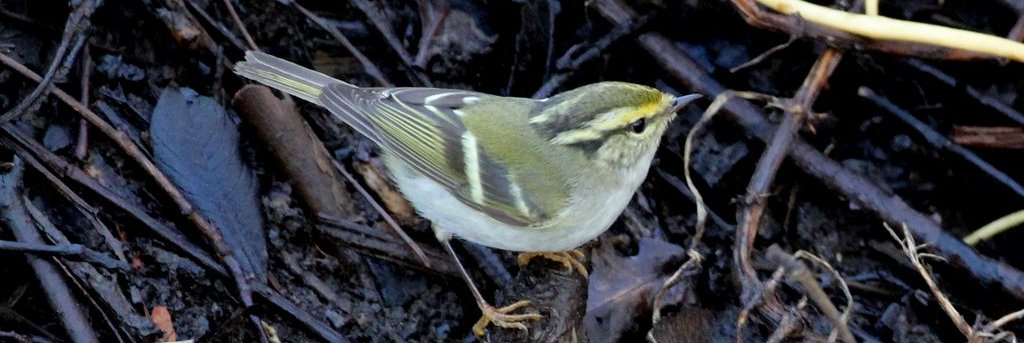
During the afternoon, we drove up to the Gelli Aur Country Park near Llandeilo. Colin took inspiration from the obligatory ice-cream and led us smartly to two active nest-boxes of Pied Flycatchers. We all had great views of both males and females as they returned often with food. This was a species which had always escaped me to date, so I had no qualms about accepting those birds as a gift on a platter!
Our hotel and base for the next three nights was in a quiet spot on the main street in Pembroke and dinner was most welcome after a long day. But orders were out for a speedy departure the next morning...
Martin's Haven, the ferry-point for Skomer, is one of those tiny places which make no sense until you find it, but we were all there early and near the front of the queue. Conditions were perfect, with hazy sunshine, balmy air and a glassy sea. Then we received the news that there would be no landings that day because of an imminent change in the weather. Incredulity all round! We had two choices: one was to wait for the 10.30 round-the-island boat-trip; the other was to decamp and drive up to Ramsey Island, where a landing would happen. And that is where the group split neatly into two. I can only say that our choice to stay with Skomer and the local headlands for the day was perfect for us, but later reports made it clear that the other group had also done well.
The defile where we waited was lively with warblers, Linnets and Swallows, but we killed some of the wait up on the cliffs, where we immediately encountered several other species, including our first Chough - another latecomer to my experience - and a pair of Ravens. But the real spectacle started when we eventually approached the island. Guillemots, Razorbills, and literally thousands of Puffins, were on the rocks, over our heads and in the water. It was amazing that, in all the hubbub, the numerous Grey Seals on the rocks could even pretend to sleep; a few opened their eyes just long enough to register us in their world of jagged rocks, sea-swell and bladder-wrack. As we progressed, Fulmars swept by on stiff wings, and Kittiwakes called from echoing recesses in the cliffs. Magnificently threatening, Herring Gulls and Great Black-backed Gulls patrolled for pirated sand-eels, a fluffy-chick takeaway, or Puffin kebab. Only the Shags and Cormorants seemed immune or indifferent, while the magnificent Gannets which passed from time to time were regally impartial. Not so the Peregrine perched high on a rocky vantage point with an eye on the main chance! With the sea still deceptively smooth in general, we slipped through the brisk tide-race and returned to the mainland after an hour of superb spectacle. The salty tang of seaweed and guano seems still to linger in the nostrils.
Our return to the cliffs brought us superb close-up views of a number of Choughs and Ravens, as well as Rock Pipits, and Wheatears. Finally, we located a pair of nesting Peregrines, she guarding two grey chicks, and the tiercel posing on the rocks a bit above her. It all made a fine spectacle for the class of primary school children who came over to share our scopes. The gasps of amazement from some reminded me of my own crucial encounter with a Barn Owl at the age of eight. I dare hope that a few future birders were converted by those falcons...
Late afternoon started to bring cooler weather, so we moved to the more sheltered area of the sea inlet at Dale. The highlight here was a trio of Whimbrel, but hunger and the promise of a special dinner lured us back for a pleasant social evening.
Saturday morning saw a keen nucleus of us out at 6.30 to explore the fine little reserve on the outskirts of town. Reed-beds and woodland gave us a variety of birds, with a pair of Bullfinches to crown the pre-breakfast list. With breakfast over, we set off in our two parties to different areas. While Colin's party set off for the southern shore, Bill's group went a short way out to the woodland area of Blackpool Mill. It took only a few minutes to find our first Dipper on the fast, shallow river and thereafter a number of Grey Wagtails and a Kingfisher. The mixed woodland was rich with birds, as our first walk brought us such as Bullfinches, Marsh Tits and several Spotted Flycatchers. As we started the second walk into an area more dominated by broad-leaved trees, the rain started, hard enough to drive a few back to the cars. Thankfully for those who persisted, we were rewarded with the song of a Wood Warbler and eventual glimpses of the bird in the dripping canopy.
The two groups swapped territories for the afternoon. Suffice it to say that our visit to the Stacks near Castle Martin was blustery and wet, with optics of reduced value, but the spectacle of the thousands of sea-birds on the towering rocks was still superb. Bill watched with awe as a cruising Great Black-back neatly grabbed the wing of a roosting Guillemot and snatched the chick it was sheltering. Meanwhile, between squalls, I had managed to spot a Manx Shearwater over the sea. The last part of the wet afternoon brought few birds - most notably hirundines dipping insects from the floating vegetation of the Lily Ponds at Bosherston, and a Rock Pipit at the beach there, but the wild-flower crop on the rocks near the beach was a real bonus.
The rain was still falling heavily on Sunday morning and we all agreed to make our way home individually, choosing such stops as weather permitted. In the event six of us decided to stop at Llanelli National Wetlands Centre. On the way up, a Red Kite near Carmarthen was probably one of the remnant native birds. By then the rain was easing and our arrival at Llanelli was only marred by a few puddles and the odd threatening cloud. To our joy there was still a Spoonbill to be found on a marshy scrape, where it was surrounded by dozens of Shelduck. As we watched, it was joined first by a Little Egret and then by a young Heron. Close-up views of Black-headed Gull chicks on the Lagoon, a small breeding flock of Black-tailed Godwits, and assorted warblers in the new extension, all added to the quality of an interesting visit. We tore ourselves away some time in the afternoon.
The weekend had been superbly organised by Colin Wilson, whose extensive research and preparations had made it all run very smoothly. Thanks, Colin! And thanks to Bill Nicholl too, for his part as second-leader. It had been all go, and wall-to wall birds. You might say that we came home puffin, and a bit raven-mad, but well-choughed!